


Our Editorial Commitment
TuneFab Ratings publishes reviews, best lists, alternatives, and troubleshooting guides to help readers evaluate music software with fewer surprises. We aim to explain not only what a product can do, but also where it may fall short, who it is best suited for, and which limitations may affect the final decision.

Practical Guidance
We focus on the questions that matter in real use, including whether a product works as expected, how restrictive its trial is, and whether its workflow and pricing fit the intended use.

Evidence Made Clear
We distinguish our own test findings from vendor-provided information and experiences reported by users or online communities. When a conclusion is not based on direct testing, we identify the basis of that information. When a conclusion is not based on direct testing, we identify the basis of that information.

Limitations Disclosed
We clearly disclose failed tests, restricted access, unsupported features, and areas we could not fully verify. A product does not need to be perfect to be recommended, but readers should be able to understand its trade-offs before making a decision.
How We Create and Review Content
We plan and review each article around the questions readers need answered before choosing, using, or troubleshooting music software. The article type, intended audience, and scope are defined before writing so that the final content stays focused and does not make claims beyond the available evidence.
Content Planning
We begin by identifying the reader’s main goal, the decisions they may need to make, and the questions the article should answer. We also define the article’s boundaries, required comparisons, and areas that need testing or further verification before drafting begins.
Writing Standards
We use clear, direct language and explain technical terms when they are necessary. Headings should accurately reflect the content beneath them, while paragraphs, lists, tables, screenshots, and links should make information easier to understand—not add unnecessary length or decoration. We avoid misleading headlines, unsupported superlatives, and claims that cannot be explained or supported in the article.
Editorial Review Before Publication
Before publication, the article is reviewed for completeness, clarity, and internal consistency. We check that the title matches the content, important limitations are visible, screenshots and links support the surrounding text, and the conclusions do not go beyond the evidence presented. Necessary revisions are completed before the article is published.
How We Select Products
We begin with the problem a reader is trying to solve rather than a fixed list of brands. A product may enter consideration because it is widely used, actively discussed, commonly compared, or relevant to a specific user need.
Reader Need and Article Purpose
Selection begins with the reader’s goal and the purpose of the article.
- Review: Products readers are actively evaluating or asking questions about.
- Best list: Distinct options that cover different user needs, rather than several near-identical tools.
- Alternative: Products that address a clear reason to switch, such as pricing, trial limits, workflow, or compatibility.
The article purpose shapes which products qualify for consideration—not their final scores or ranking.
Current Relevance and Availability
We consider whether a product is still available, maintained, and usable on the platforms or in the markets covered by the article.
Discontinued, inaccessible, or non-working products may be excluded unless their current status is itself relevant to the topic.
Meaningful Product Differences
We prioritize products that add a genuinely different option to the comparison. Rebranded or near-identical tools may be grouped, deprioritized, or excluded unless they differ meaningfully in functionality, pricing, support, platform coverage, or user experience.
Ability to Evaluate the Product
A product is more likely to be included when we can test it directly or gather enough reliable information to assess its key claims. Limited trial access does not automatically disqualify a product, but it may narrow what we can confirm. Any important evaluation limits are disclosed in the article.
Selection does not determine ranking. Inclusion means a product is relevant enough to evaluate; final scores, verdicts, and recommendations are determined through the separate testing and rating processes described below. Ownership alone is not a sufficient reason for inclusion.
How We Test Music Converters
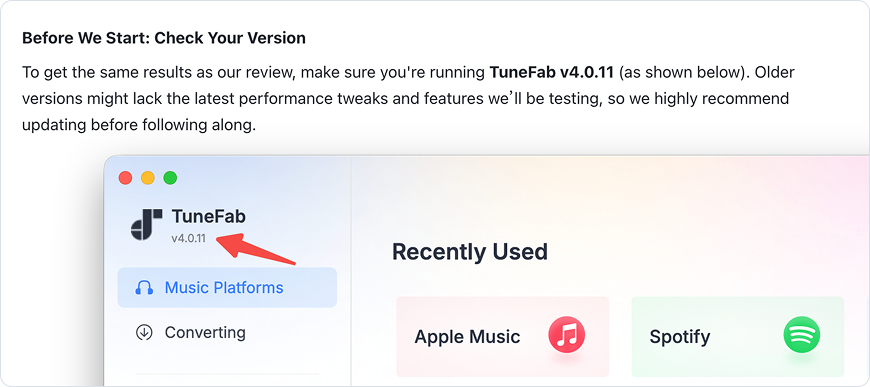
Hands-on testing begins with a defined test scope. We record the product version, test date, device and operating system, streaming account type, and whether we are using a free trial or paid license. The exact scope may vary by product, but the conditions and any important limits should be clear in the individual review.
Test Setup and Scope
Where possible, we test comparable products under similar conditions, using the same device, network environment, account type, and music samples. For comparison and alternative articles, we also try to use the same tracks, albums, or playlists so that differences in speed, stability, and workflow are easier to evaluate fairly.
We do not assume that results from one operating system, account tier, or product version apply universally. When only one platform or access level has been tested, we state that limitation.
Real-World Test Tasks
Tests are designed around the way readers are likely to use the software. Depending on the product and article purpose, this may include:
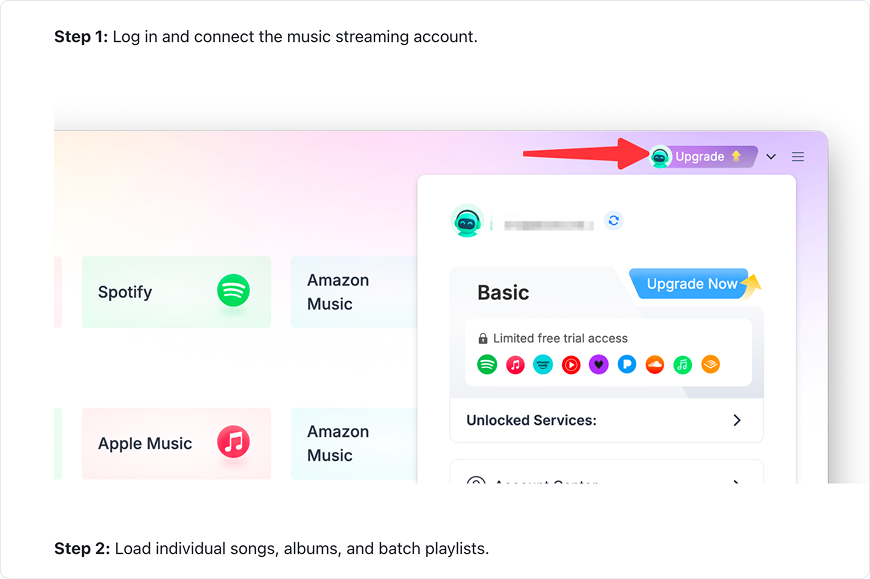
- signing in or connecting to the supported music service;
- loading individual tracks, albums, and playlists;
- processing larger playlists or batch tasks;
- selecting output formats and quality settings;
- starting, pausing, retrying, and completing downloads;
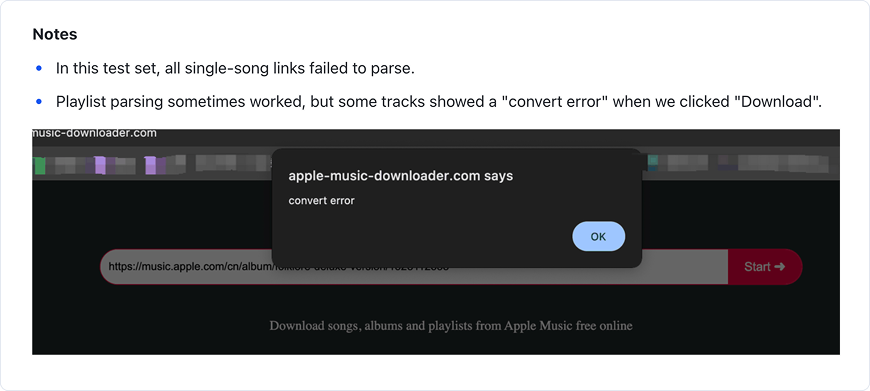
- checking how the product handles unavailable tracks, failed tasks, or interruptions.
Not every product is tested with the same number of songs or every supported format. The scope depends on the claims being evaluated and the access available during testing.
Results We Record
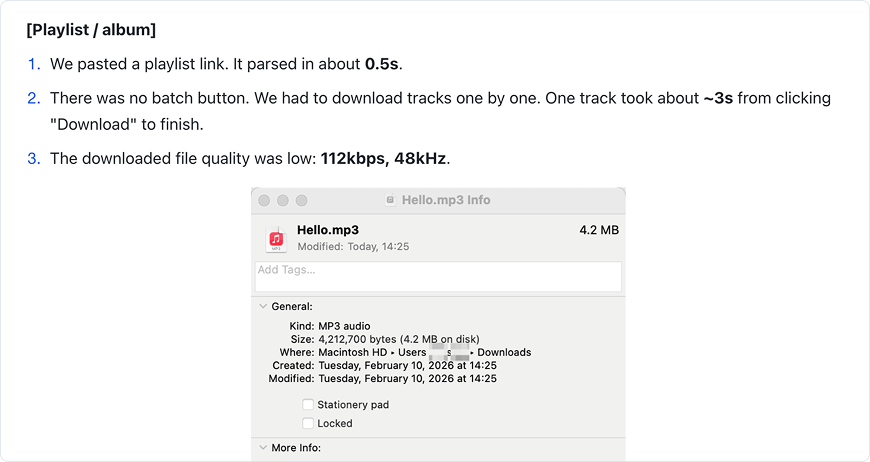
We may record download success, parsing and conversion speed, stability, output formats, bitrate or other file properties, metadata retention, batch performance, usability, and trial restrictions. We also note workflow problems such as repeated login requests, missing tracks, incorrect output, unexpected redirects, or features that lead to a paywall.
When results are inconsistent, we repeat the task where practical instead of relying on a single attempt.
Testing Limits and Documentation
Failed tests, restricted features, inaccessible paid functions, unsupported systems, and areas we could not fully verify are treated as part of the result rather than omitted. Reviews may include screenshots, test notes, sample details, or file information where these help readers understand the evidence.
Testing produces the first-hand findings used in our reviews. How those findings affect scores, verdicts, and recommendations is explained separately in the next section.
How We Rate and Recommend Products
Our ratings summarize how well a product performs for its intended use. We consider both what worked and what did not, rather than awarding a high score simply because a product offers more features or makes stronger claims.
Core Evaluation Areas
The exact criteria may vary by product type, but comparable music converters are generally evaluated across similar areas, including:
- download or conversion success;
- speed and batch performance;
- output quality and file properties;
- metadata retention;
- workflow and ease of use;
- stability and error handling;
- platform compatibility;
- free-trial restrictions, pricing, and overall value.
Not every criterion carries the same importance in every article. For example, batch stability may matter more in a playlist downloader comparison, while output controls may be more important when reviewing a format-focused converter.
From Test Findings to Scores
When a review includes numerical scores, they reflect the overall evidence available for each evaluation area. Scores are not based on feature count alone, and one strong result does not automatically cancel out serious problems elsewhere.
Repeated failures, misleading trial conditions, missing tracks, unstable performance, or major differences between advertised and observed results may have a greater effect on the final rating than minor conveniences or extra settings.
Our scores represent an editorial assessment of the available evidence rather than a universal mathematical formula. Where testing access is limited, we limit our conclusions to what could reasonably be verified.
Verdicts and “Best For” Recommendations
A final verdict explains the main strengths, limitations, and suitable users in plain language. A product may still be recommended despite having drawbacks when those drawbacks are clearly disclosed and unlikely to affect its intended audience.
“Best for” labels are based on specific use cases rather than the overall score alone. A product may be a strong choice for beginners, large playlists, format control, occasional use, or budget-conscious users without being the best option for everyone.
Ranking Products in Comparisons
In best lists and alternative articles, ranking reflects the purpose of the comparison and the needs behind the search. We consider performance, reliability, value, ease of use, meaningful advantages, and important trade-offs.
The highest numerical score does not automatically determine every position. Each placement should match the stated user scenario and be supported by the findings presented in the article.
Scores and labels summarize the evidence rather than replace it.
Ownership and Commercial Disclosure
TuneFab Ratings is operated by TuneFab and covers both TuneFab products and third-party music software. We disclose this relationship so readers can understand the context behind our reviews. TuneFab products may be included when they are relevant to the topic, but ownership alone does not guarantee inclusion, a higher score, or the top position in a comparison. Articles may also contain download buttons, purchase links, or discount information; these commercial elements do not replace the testing evidence, limitations, and evaluation presented in the article.
Sources and Fact-Checking
We verify product details such as features, compatibility, supported formats, pricing, and trial limits through official websites, help centers, release notes, and other reliable documentation. Time-sensitive information is checked as close to publication as practical, and unclear or conflicting claims may be compared across multiple sources.
User reviews, forums, Reddit discussions, and other community feedback help us identify recurring concerns and real-world experiences, but individual reports are not presented as confirmed facts unless they can be reproduced or independently supported. AI tools may assist with research organization, language refinement, or quality checks, while factual claims, interpretations, and final conclusions remain subject to human review.
Updates, Corrections, and Reader Feedback
We review and update articles when meaningful changes may affect a reader’s decision, such as major product updates, pricing or trial changes, compatibility issues, discontinued features, or results that can no longer be reproduced. When new evidence changes the original assessment, scores, verdicts, or recommendations may also be revised.
If we identify a factual error, we correct it rather than leaving outdated or misleading information in place. Readers may also contact us to report errors, share updated product information, or question a test result. Relevant feedback is reviewed and verified before any change is made.
These standards are designed to make our reviews easier to understand and evaluate—not to ask readers to accept our conclusions on trust alone. Whenever we recommend a product, the supporting tests, limitations, and reasoning should be visible in the article itself.
Have a question or spotted an error? Contact our editorial team